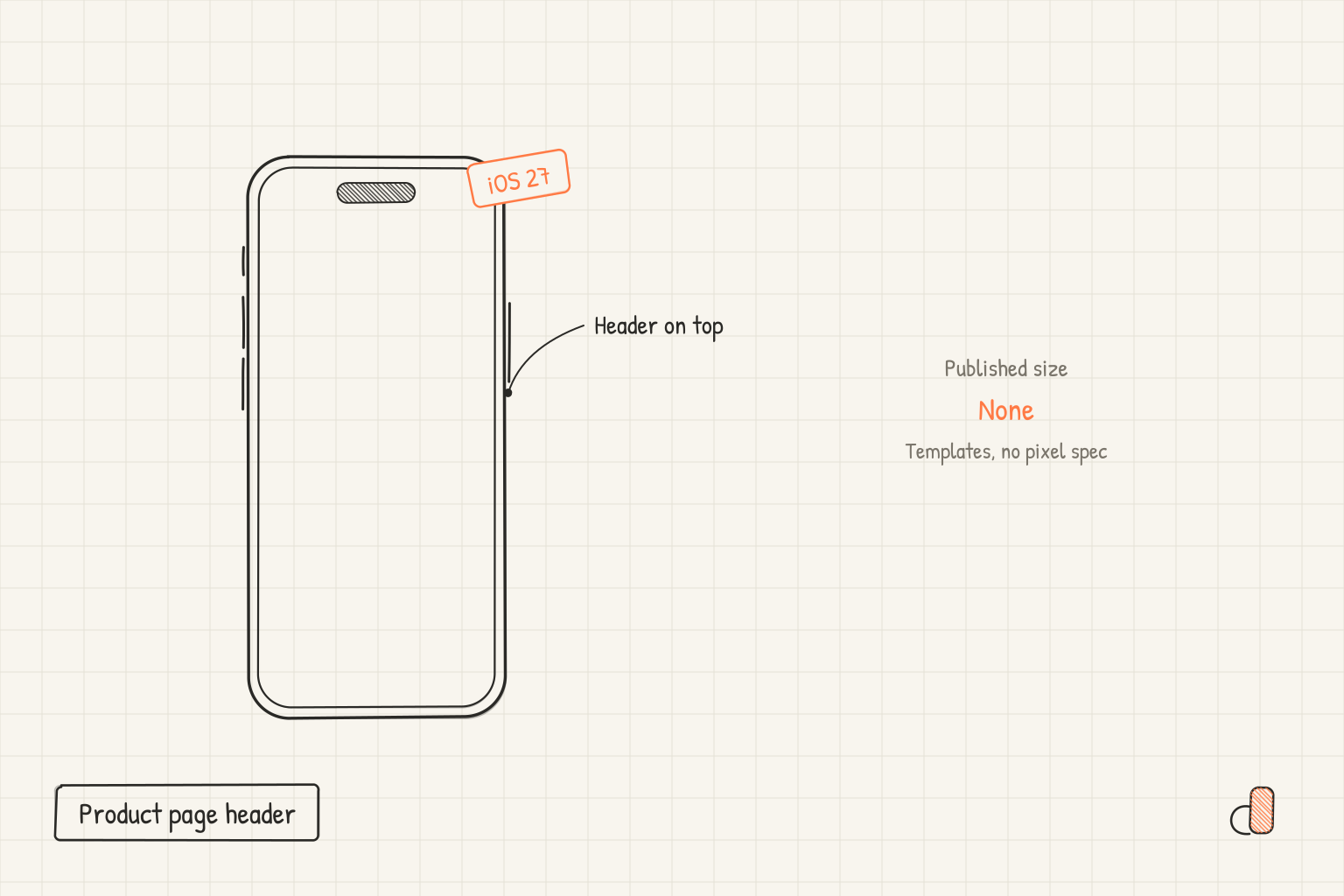
Quick Answer
Apple publishes no pixel dimensions for the App Store product page header. It ships downloadable Figma, Photoshop, Pixelmator and Sketch templates instead, and as of September 20, 2026 neither the asset guidance page nor App Store Connect Help states a header width or height. What Apple does state is where these images and videos land: creative assets appear across the App Store in iOS 27 and iPadOS 27 and later, in your product page header, in search results, on custom product pages, in product page optimization tests and in Apple Ads. Screenshots keep their own slots: up to 10 on the product page, of which up to three can appear in search results depending on orientation.
Where creative assets appear
A developer news post dated August 5, 2026 says the assets "can be used across the App Store in multiple places, including your product page header, search results, In-App Events, and more". The full list sits on the App Store asset best practices page and on What's New in App Store.
| Placement | What Apple says about it |
|---|---|
| Product page header | The first thing someone notices on your product page. Images or video. |
| Search results | An image or video in place of the default screenshots and previews, on the App Store and in the Apple Games app. |
| Custom product pages | Creative assets can be used on your custom product pages. |
| Product page optimization | Test alternative header visuals and see which performs best. |
| Apple Ads | Campaigns on the Today tab and in search results. |
| In-App Events | Event card at 16:9 landscape, event details page at 9:16 portrait. |
One placement has a documented stand-in. Apple's asset guidance says that if you choose not to use a search result creative asset, "your In-App Events, app previews, and screenshots will appear". It describes that stand-in for search results only, so treat the header as a slot you fill deliberately. In the WWDC26 session Enhance your presence on the App Store, Apple says you can update your header and search result visuals on both iOS 27 and iPadOS 27.
What has to stay out of the artwork
Apple sends you to two rulebooks before you open a template: App Review Guidelines section 2.3 on accurate metadata, and the Apple Advertising Policies. Its own list of things to leave out of an asset is short and specific.
- No specific pricing, discounts, website URLs or copyright symbols, which Apple frames as keeping the asset relevant to a global audience.
- No claims that cannot be verified, such as awards your app or game has not actually received.
- No logos or references to other platforms or marketplaces. Guideline 2.3.10 says the same about metadata in general, so an Android device frame in an App Store asset breaks both rules at once.
- No Apple-designated recognitions such as Editor's Choice, App of the Day or Apple Design Award winner, because Apple says many of these already appear alongside your app.
- A 4+ age rating even when your app's own rating is higher. Games with violence may use action imagery, but Apple rules out gore, graphic imagery, and weapons pointed directly at a person or the audience.
Here is a concrete check. Open the asset at full size and read every word and mark inside the frame, including anything baked into a screenshot reused from your marketing site: a price, a percentage-off badge, a web address in a corner, a copyright line under a logo. The fix is to remove the element rather than soften it, because a reworded price claim is still a price claim. The screenshots underneath have their own file rules, covered in our post on screenshot upload errors.
Two ways to get an asset approved
The version route is the familiar one. Upload the assets on your app's version page, preview the page, and submit the version for review. When the version is approved and released, the header and search result assets go live with it.
The Asset Library route submits creative assets on their own, without updating your version and without indicating where you plan to use them. Once approved, Apple says they are ready to use across your product page header and search results "without going through additional reviews", and session 205 demonstrates swapping a header from a summer asset to a winter one by publishing the change directly to the App Store without a new submission. Both routes can also be driven through the App Store Connect API.
Prefer the Asset Library route for anything seasonal, because approval stops being tied to your release train. On availability, be precise with yourself: Apple's What's New in App Store page marks both the Asset Library and the product page preview tool "Coming this fall", and the App Store Connect release notes, whose most recent entry as of September 20, 2026 is dated September 18, 2026, carry no entry for either.
Designing a header without a stated size
Apple's format guidance is the closest thing to a brief. Keep key elements readable, because assets appear differently across the App Store. Design with a safe area in mind for different devices and orientations, and keep your focal point artwork within the center of the composition to prevent unwanted clipping. For the header, Apple asks you to focus on a single, clear idea, on the grounds that "visually dense or cluttered assets dilute your impact".
Make one universal asset before you make two. Apple's guidance says you can use a universal creative asset for your header and search results asset to strengthen brand recognition across the App Store, and it offers universal templates in all four design tools it lists, against header-only templates in two. One file that works in both slots is less artwork to produce and less to keep in sync.
Start with a still image rather than a video. Apple's video guidance asks for a poster frame that is compelling on its own, a loop with no visible jumps or breaks, and a creative that works silently first because audio is muted by default in most cases. That is a production, and it can join an approved library later. Then check the result where Apple checks it: the asset guidance says you can use the Preview tool in App Store Connect to see how assets appear before they are live, and session 205 says that preview covers iPhone and iPad across orientations and languages.
Building the matching screenshot set for free
Apple's instruction for the set as a whole is that the pieces should look like each other: "consider using similar visual style, such as color palette, iconography, fonts, message, and tone". The header sets that palette, and the screenshots below it carry it.
That part you can do in appdesigns at no cost. It runs in the browser, needs no account to create or export, adds no watermark, and gives unlimited PNG exports. Canvas presets cover every accepted App Store class, from the 6.9 inch iPhone down to the 4.7 inch, plus iPhone Duo, iPad, Mac and Apple Watch, each with a landscape version. Set an image, gradient or colour background, add headline text, tilt the device, pick a frame or drop it entirely, and keep every screen in a project on one device kind. The size reference lists the dimensions on their own.
Two limits worth stating plainly. There is no header canvas in it, because Apple publishes no header size to build a preset from, and it does not make videos, app icons or localised copy. It also does not check files against store rules or upload anything to App Store Connect, so the reading pass above is still yours to run.
Frequently Asked Questions
What size is the App Store product page header?
Apple gives design templates rather than a stated pixel width and height. As of September 20, 2026, the asset best practices page links Figma, Photoshop, Pixelmator and Sketch templates, and the App Store Connect Help reference section carries no creative asset specifications page. Build inside the template and preview the result in App Store Connect.
Do I still need screenshots if I add a header?
Yes. Apple's asset guidance still describes up to 10 screenshots on your product page, with up to three able to appear in search results depending on orientation, and treats them as the asset that shows your app in use. The header sits above them and expresses your brand instead.
Can one asset cover both the header and search results?
Yes. Apple calls it a universal creative asset and says you can use one for your header and search results asset to strengthen brand recognition across the App Store. Universal templates are offered in all four design tools Apple lists.
Can I change the header without shipping a new app version?
Apple's session 205 says approved assets in the Asset Library can be used across your header and search results without going through additional reviews, and demonstrates a swap published directly to the App Store without a new submission. That depends on the Asset Library being available in your App Store Connect account, which Apple's What's New in App Store page labels as coming.